
In popular communities, it is often necessary to track the sentiment of comments in order to monitor the community’s progress, or even people’s attitudes towards individual posts.
Social networks provide a unique platform for interacting with clients and potential consumers. However, simply “being on social networks” is not enough. To use social platforms effectively, businesses need to understand how users react to their content, products, or services. One way to achieve this is by tracking the sentiment of comments.
Why is this necessary?
Understanding the Audience
Sentiment analysis helps you understand the mood of your audience. This can be useful for identifying problems or opportunities that require your business’s attention.
Reactive Marketing
Quickly identifying negative feedback allows your company to respond promptly, minimizing potential reputational damage.
Strategic Planning
Long-term sentiment analysis of comments can help in making strategic decisions, such as making changes to a product or adjusting a marketing campaign.
What tools are there to track comment sentiment?
Artificial Intelligence
Today, there are many AI-based tools that automatically analyze text sentiment. Examples of such tools: Google Natural Language, IBM Watson Tone Analyzer, and others.
Software Solutions
There are also many SaaS solutions specifically designed for social monitoring, such as Hootsuite, Mention, or Brandwatch.
However, a significant drawback is their price. Hootsuite, for example, costs from $100 per month. For large businesses, this may be acceptable, but for small businesses or running public pages, it is debatable whether this tool brings that much benefit.
In addition, many Western systems poorly process the Russian language and do not support such “exotic” social networks for them as, for example, Odnoklassniki.
Manual Analysis
In addition to automated systems, many companies still use manual analysis to assess the sentiment of comments on social networks.
The main factor here is how convenient it is for the operator performing the analysis to quickly tag comments, create new tags, and so on.
Operators process large volumes of comments, and for them, speed and ease of work, as well as minimizing effort, are important.
Comment sentiment is a complex task
Dependence on Context
Sentiment often depends on the context in which it is expressed. For example, the comment “interesting” can be either positive or negative in different circumstances, depending on what was said before.
Comments with swear words are even harder to process. I wouldn’t even want to mention this, but you can’t take words out of a song) Swear comments do occur, there are many of them, and their sentiment 100% depends on the context in which they are expressed, because the same word can mean both positive and negative things.
Limitations of Artificial Intelligence
Even the most advanced AI algorithms can make mistakes in determining sentiment due to irony, sarcasm, profanity, or complex sentence structures.
Tagging systems for comment sentiment
When you start working with comment sentiment, one of the main questions becomes — by what system to do it.
The most basic option is as follows:
- Positive,
- Neutral,
- Negative.
Sometimes “Undefined” is also added to distinguish it from “Neutral” when the neutrality of the comment is clearly understood.
However, you may also want to track the “strength” of the emotion — for example, how positive or negative the comment is, because, for example, between the phrases “useless feature” and “damn it, once again you introduced some useless crap” — there is a significant difference, and it would be good to take this into account for analysis.
Then your tagging system might look like this:
- +3
- +2
- +1
- 0
- -1
- -2
- -3
In general, you can come up with any system you like, the important thing is that you can offer reasonable rules for how to use it.
How to track comment sentiment
In the end, we come to the conclusion that for correct work with sentiment there is no better way than involving a human.
Thus, the task breaks down into two:
- Collect comments in the communities you are interested in
- Tag comments by their sentiment according to the division you have set.
In our opinion — the best tool for working with comment sentiment is the Chotam.ru service.
Firstly, the work with comment tags for operators is built in an ultra-convenient and simple way, you can simply click on tag buttons in the comment log to mark comments, and via the link the operator can easily open the comment and read the context if in doubt.
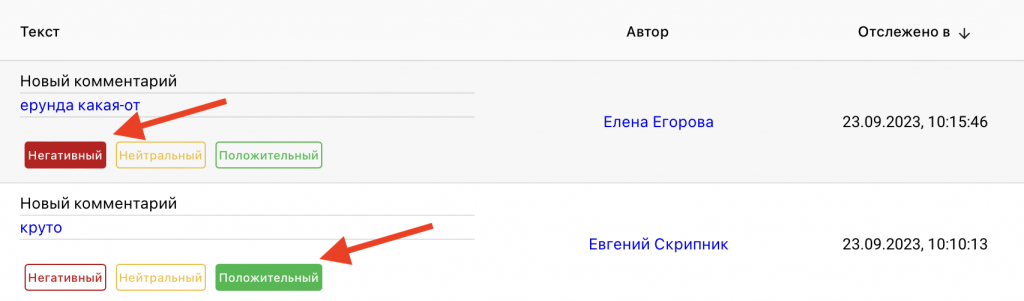
Secondly, there you can set up absolutely any tag or tagging system, and also partially automate the work (after all) — for example, automatically mark comments with profanity using a “bad words” dictionary or other unwanted mentions.
And finally, the service has a special staff of people who, according to your specified criteria, but with “human intelligence” and taking context into account — will tag your comments for you. To do this, you need to request an “individual rate” on the website.
Although modern technologies provide many tools for automatic sentiment analysis, this task remains complex and multifaceted. Due to dependence on context and the limited capabilities of artificial intelligence, the best approach may be a combined method, in which manual analysis complements automatic tools. An experienced specialist will be able to take into account the context and nuances of the language, making the analysis more accurate and useful for your business.
Leave a Reply